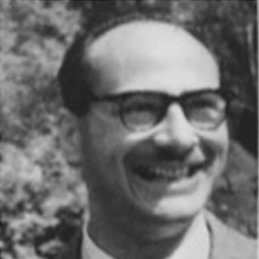
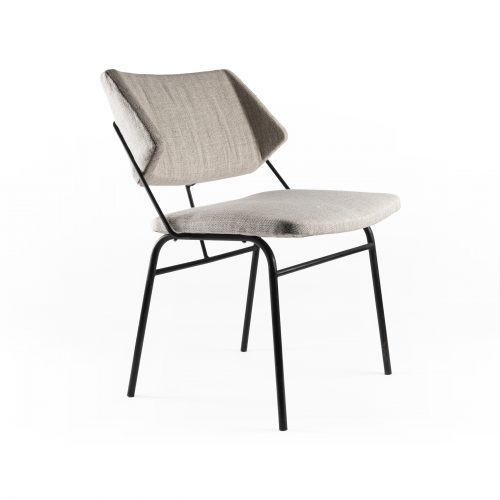
Raphaël Raffel, known simply as Raphaël, apprenticed at Jansen between 1929 and 1934.
After studying at the École des Beaux-Arts, Raphaël — whose early clients included Joséphine Baker — set himself up as a decorator in 1934. While he met private commissions in the spirit of his time, he always managed to assert a fresh and distinctly personal touch. The post-war period only further confirmed the lightness that emanates from his creations.
His style flourished after the war and evolved with the use of new materials such as lacquer and, from 1953 onward, glass for table bases following the Securit competition. He combined materials whose luxury and fine craftsmanship were always linked to utility, comfort, and even ergonomics. For fabric and tapestry designs he collaborated with René Fumeron, for ceramics with Georges Jouve, for furniture bronzes with Georges Levy-Mazaud, and of course with Paul-Étienne Saïn and Henri Tambuté for their Béka lacquer, in exclusive shades of almond green, dark red, clouded effects and golden nuances, patented in 1948.
Raphaël exhibited at the Salon des Arts Ménagers starting in 1939 and at the Salon des Artistes Décorateurs from 1955.
At the end of the 1950s, his agency experienced a considerable influx of public commissions: at a time when the State was concerned with the notion of brand image associated with public service, he was responsible for the interiors of post office buildings (rue d’Ulm, rue du Louvre), embassies, university residences (notably the Antony residence with Jean Prouvé and Serge Mouille), the National Assembly, and finally the ground floor and left wing of the Hôtel de Ville de Paris. He was also invited to exhibit at the 1958 Brussels World’s Fair, alongside Dumond, Arbus, Adnet, Sognot, Richard, Leleu, Motte, and Old.
During the 1960s, Raphaël worked mainly for major public institutions. His highly personal style evolved slowly. Wall sconces at this time were crafted in gilded bronze by Agostini or Durantet. Wood veneer disappeared entirely, giving way almost systematically to glass bases for furniture, or alternatively to metal or Béka lacquer.
Inimitable in his style, Raphaël is now regarded as one of the greatest French decorators of the 20th century.